

Picking the right flow meter is not simple. When you look at electromagnetic vs ultrasonic flow meters both seem like good options at first glance. So which one is right for you?
It depends on a few things. Your fluid type, conductive it is flow range and Pipe size. Accuracy needs. Installation conditions. Pressure and temperature. And whether you want a permanent setup or something non-invasive.
Electromagnetic meters work well for conductive liquids like water, wastewater, and many process fluids. Ultrasonic meters, especially clamp-on ones, work well when you need flexible or non-invasive installation.
This guide compares both in plain terms, so you can make the right call for your plant.
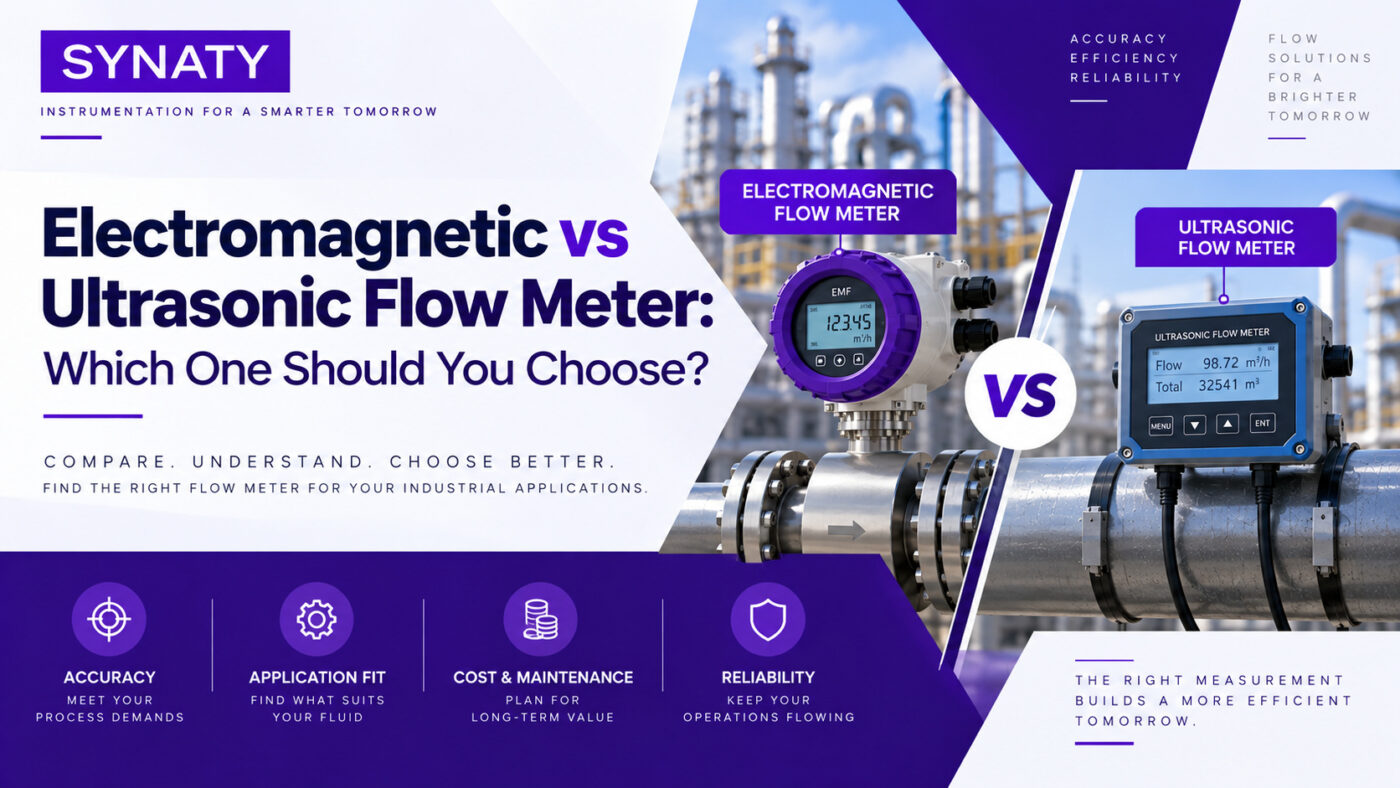
Electromagnetic vs Ultrasonic Flow Meter: Quick Comparison
| Feature | Electromagnetic Flow Meter | Ultrasonic Flow Meter |
| Measurement principle | Electromagnetic induction | Sound waves |
| Best suited for | Conductive liquids | Depends on the ultrasonic tech |
| Installation | Usually inline | Inline or clamp-on |
| Pipe modification | Usually needed | Not needed for clamp-on |
| Moving parts | No | No |
| Pressure drop | Very low | Very low for clamp-on |
| Retrofit | More work | Clamp-on is easy |
| Water measurement | Excellent | Excellent, if suitable |
| Wastewater | Excellent, if conductive | Depends on application |
| Temporary measurement | Not ideal | Great with portable units |
| Non-conductive liquids | Not suitable | Can work, depends on fluid |
| Large existing pipelines | Possible | Clamp-on is very convenient |
technology is not best every time. The right choice depends on your process.
What Is an Electromagnetic Flow Meter?
People also call it a mag meter. It measures conductive liquids using electromagnetic induction.
It works on Faraday’s Law: conductive liquid moving through a magnetic field creates a small voltage. The meter reads that voltage and turns it into a flow number.
There’s nothing moving inside the meter. That means less wear and fewer breakdowns.
Where Are Electromagnetic Flow Meters Used?
- Drinking water
- Industrial water
- Wastewater
- Sewage
- Cooling water
- Conductive chemicals
- Acid and alkaline solutions
- Process liquids
- Slurries with suspended solids
Because nothing blocks the pipe, these meters handle solids in liquids better than mechanical meters, which can clog.
Synaty’s electromagnetic flow meter works for conductive liquids. It fits pipes from 10 mm to 2000 mm. You get options in liner and electrode material. Output signals include 4–20 mA, pulse, RS485, RS232, HART, and Modbus. That means it plugs into most existing control systems without extra hardware.
What Is an Ultrasonic Flow Meter?
It uses sound waves to measure flow.
There are two common types transit-time and Doppler. Transit-time works best for clean liquids. Doppler works better when the liquid has bubbles or particles in it.
The biggest advantage here is easy installation. A clamp-on ultrasonic meter sits outside the pipe. You don’t need to cut anything. You don’t need to shut the process down.
This makes it useful for:
- Existing pipelines
- Large pipes
- Temporary checks
- Flow surveys
- Energy audits
- Verifying another meter
- Retrofit jobs
- Places where shutdown is hard
Synaty offers portable ultrasonic meters and wall mounted clamp on units. Portable ones are handy if you need to check flow at several sites without buying a separate meter for each.
Electromagnetic vs Ultrasonic Flow Meter: Key Differences
Measurement Principle
Electromagnetic: Uses a magnetic field and electrodes. The liquid must conduct electricity for this to work.
Ultrasonic: Uses sound waves passing through the fluid. In transit-time meters, the time difference between signals tells you the flow speed. Even a little trapped air can throw this off.
Fluid Type and Conductivity
This is the biggest factor in choosing between the two.
Electromagnetic: It needs a conductive liquid. Water and wastewater usually work well, but deionized water and oil usually don’t because they aren’t conductive enough.
Ultrasonic: Doesn’t need conductivity. This makes it useful for fluids that mag meters can’t handle, like oils and solvents. But the fluid still needs to carry sound waves cleanly.
Simple rule: Don’t pick a meter just because your fluid is a liquid. Check conductivity for electromagnetic. Check sound clarity for ultrasonic. They’re two different checks.
Accuracy and Measurement Performance
Accuracy matters a lot if you’re using the data for billing or process control.
Electromagnetic meters give strong accuracy when sized correctly. Synaty’s model offers 0.5% accuracy, with 0.2% as an upgrade option. One tip an oversized meter running at low speed can lose accuracy even if the spec sheet looks great.
Ultrasonic accuracy depends more on conditions. Things that can throw it off:
- Pipe material
- Pipe wall thickness
- Scaling inside the pipe
- Fluid condition
- Transducer position
- Flow profile
- Air bubbles or solids
Old pipes with mineral buildup are a common, often-missed problem here.So don’t judge a meter by its spec sheet alone. Installation conditions matter just as much.
Clamp-On Ultrasonic Flow Meter
Electromagnetic (inline): Goes directly into the pipe. Usually needs:
- Pipe modification
- A shutdown during install
- Flanges or connections
- Proper straight pipe before and after the meter
This straight-pipe requirement is easy to forget, but skipping it hurts accuracy.
Ultrasonic (clamp-on): Mounts on the outside of the pipe. No cutting needed.
Good for:
- Processes that can’t stop
- Expensive pipe modification jobs
- Temporary checks
- Double-checking another meter’s reading
- Surveying multiple pipelines
If you want zero pipe interference, clamp-on ultrasonic wins here.
Pipe Size
Synaty’s electromagnetic meter covers 10 mm to 2000 mm pipes.
Ultrasonic clamp-on also works well on large pipes, since the sensor sits outside. On big pipelines, this often saves money compared to cutting in an inline meter.
But pipe size alone shouldn’t decide your choice. Also check:
- Minimum, normal, and maximum flow rate
- Pipe material and wall thickness
- Lining
- Flow profile
- Available space for installation
Pressure Drop
A good electromagnetic meter barely restricts flow, since there’s no turbine or blockage inside. Over time, this can even save on pumping costs.
Clamp-on ultrasonic meters sit outside the pipe, so they don’t touch the fluid path at all.
Both are good choices if you want to avoid disturbing your existing hydraulics.
Maintenance Requirement
Neither meter has moving parts inside, which already puts them ahead of mechanical meters.
But they still need care. Electromagnetic meters need good electrode condition and proper grounding. Bad grounding is a common issue it can look like a hardware fault when it’s really just a wiring problem.
Ultrasonic clamp-on meters need correct sensor placement and good contact with the pipe. Pipe condition affects the signal quality.
Synaty’s ultrasonic water meter has no moving parts, which cuts down on wear and upkeep.
Electromagnetic vs Ultrasonic for Water
Both work well for water. Here’s how to decide:
Go electromagnetic if:
- The water is conductive enough
- You want a permanent setup
- You can modify the pipeline
- You need continuous reliable readings
- It’s wastewater or has suspended solids
Go ultrasonic if:
- You want non-invasive installation
- You can’t cut the pipe
- The pipeline is already running
- You need temporary or portable measurement
- Your fluid fits ultrasonic requirements
Synaty offers both, so the technology can match the job instead of forcing one option on every project.
Which flow Is Better for Wastewater?
Wastewater usually carries suspended solids and stays conductive. That favors electromagnetic meters, since nothing inside the pipe can clog or wear down.
Synaty’s electromagnetic meter is built for sewage and industrial discharge too.
Still, ultrasonic can make sense for certain existing pipelines or retrofit jobs where cutting in a new meter isn’t practical.
Check your actual fluid and pipeline before assuming one option is always right.
Which Is Better for Industrial Applications?
There’s no single right answer. Ask what your application actually needs.
Go electromagnetic if:
- Your liquid is conductive
- You want a permanent install
- You’re measuring water or wastewater
- Solids are present in the liquid
- Your pipeline supports an inline meter
Go ultrasonic if:
- You want non-invasive measurement
- Modifying the pipeline is hard
- Shutdown is costly
- You need temporary or portable readings
- You’re working with an existing pipeline
Electromagnetic vs Ultrasonic Flow Meter: Decision Guide
Is the fluid conductive?
Yes (Electromagnetic is a strong option).
No (Look at ultrasonic instead).
Can you modify the pipeline?
Yes (Either technology can work).
No (Clamp-on ultrasonic has a clear edge.)
Is the measurement permanent or temporary?
Permanent (Either, sized correctly).
Temporary (Portable ultrasonic is ideal).
Is it water or wastewater?
Electromagnetic is usually the safer starting point.
Is the pipeline already running?
If shutdown or cutting is difficult, check if clamp-on ultrasonic fits.
What Should You Consider Before Buying?
- Fluid name
- Fluid conductivity
- Minimum, normal, and maximum flow rate
- Pipe diameter, material, and wall thickness
- Operating pressure and temperature
- Required accuracy
- Installation type
- Available straight pipe length
- Output signal needed
- Power supply
- Where it will be installed
People often forget straight pipe length. It directly affects how accurate your reading will be, so don’t skip it. Sharing this list with your supplier gets you the right meter not just one that fits your pipe size.
Why Choose Synaty for Flow Measurement?
Synaty offers electromagnetic, ultrasonic, thermal mass, vortex, turbine, Woltmann, ultrasonic water meter, and oval gear technologies all under one roof.
That means the choice starts with your application not with whatever one product a single vendor happens to sell.Explore our flow measurement technologies to compare the available options.
Synaty also has portable and wall-mounted ultrasonic clamp-on units alongside their electromagnetic range.
Whether you’re measuring water, wastewater, chemicals, gas, oil, or solvents start by understanding your conditions, then pick the technology that fits.
Final Verdict: Electromagnetic or Ultrasonic?
If you’re measuring conductive water, wastewater, or similar liquids and can install a permanent meter go electromagnetic.
If you need non-invasive installation, easy retrofits, or temporary measurement go ultrasonic clamp-on.
Don’t ask which one is better overall. Many plants use both electromagnetic for permanent, billing-grade points, and ultrasonic for spot checks and audits.
Instead, ask for Which one fits my fluid, my pipe, and my process?
That question gets you a meter that actually works without extra installation or maintenance headaches.
Still not sure? Check our guide on how to choose the right flow meter for your industrial application, or share your fluid type, pipe size, flow range, and installation setup with a flow measurement specialist.
Frequenlty Asked Question
Is an electromagnetic flow meter better than an ultrasonic flow meter?
Not really it depends on your fluid. Electromagnetic works best for conductive liquids and permanent setups. Ultrasonic gives you more flexibility, especially with clamp-on models.
Which is better for water: electromagnetic or ultrasonic flow meter?
Both work well for water. Pick electromagnetic for a permanent setup with conductive water. Pick ultrasonic if you need a retrofit, temporary check, or non-invasive install.
Can an ultrasonic flow meter measure non-conductive liquids?
Yes, in many cases. It depends on the meter type and the fluid. Always check the manufacturer’s specs first.
Do electromagnetic flow meters have moving parts?
No They use electromagnetic induction, not mechanical parts. Less wear, less maintenance.
Can I install an ultrasonic flow meter without cutting the pipe?
Yes Clamp-on ultrasonic meters mount outside the pipe. No cutting, no shutdown needed.
Which flow meter is more accurate?
Both can be very accurate it comes down to correct sizing and proper installation, not just the technology.
Which flow meter should I choose for my industrial application?
Start with your fluid type, conductivity, flow range, pipe size, and accuracy needs. Then match those to the right technology, not just the price.
