

If you work in manufacturing or process industries, you already know this getting your flow measurement wrong can throw off your whole operation. It can mess with production, quality, energy use, and process control. So picking the right flow meter isn’t a small decision.
The tricky part is that there are so many types out there Electromagnetic, ultrasonic, vortex, thermal mass the list goes on. Which one do you actually need?
Honestly, it depends. It comes down to your fluid, your flow range, your pipe size, your pressure and temperature, how accurate you need to be and how it’ll be installed.
Let’s walk through it step by step, so you can figure out what actually fits your situation.
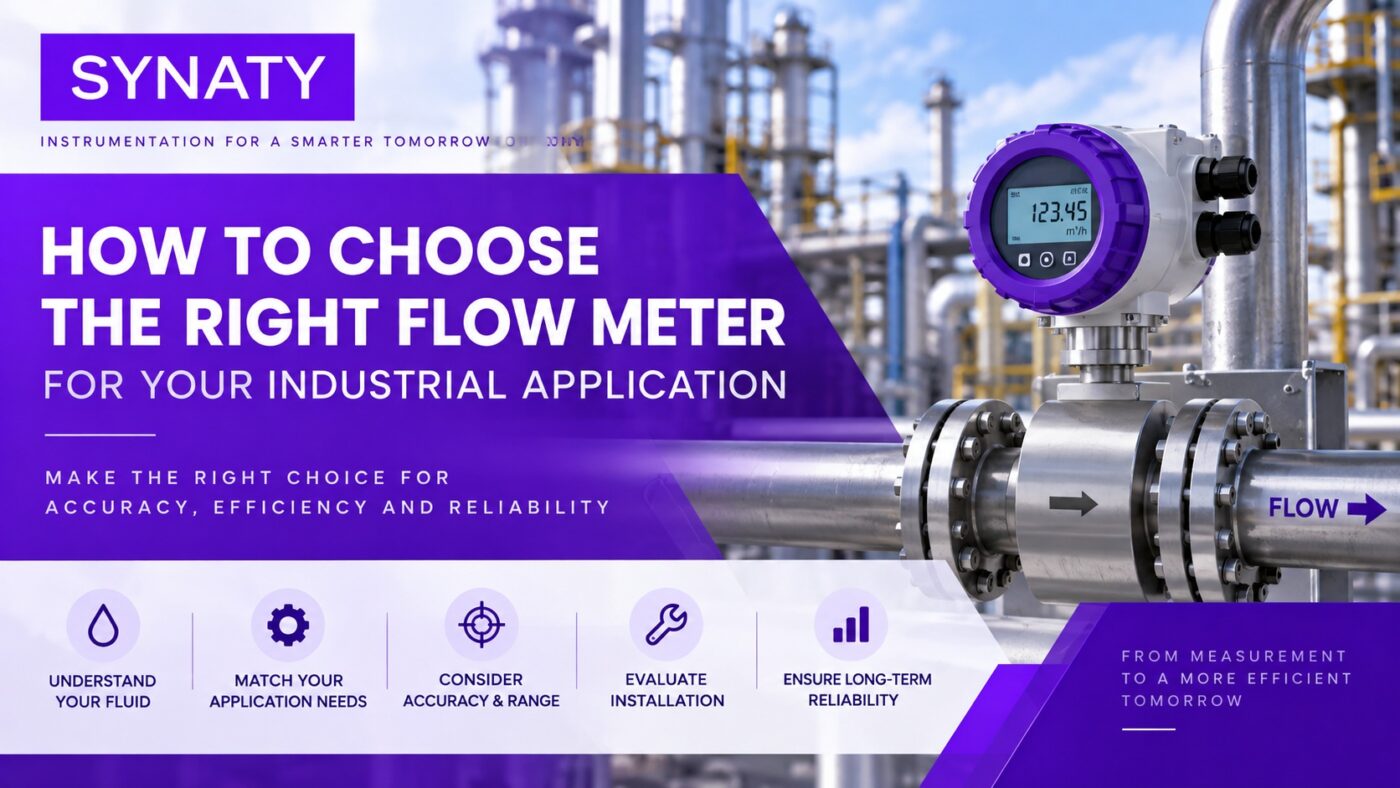
Why This Choice Actually Matters
A flow meter isn’t just a dial that tells you a number It’s part of how you run your process.
Get it right and you’ll:
- See more accurate readings
- Keep better tabs on production
- Control how much water, gas, air, or steam you’re using
- Catch problems before they get worse
- Run things more efficiently
- Waste less
- Plug it into your automation setup without a fight
- Spend less time and money on maintenance
Get it wrong say, you just pick something based on pipe size or price and you’re looking at bad readings, installation problems, and higher costs later on.
Instead of choosing from a catalog first identify your application needs and select the technology that fits.
Start With What You Actually Need
Before you even start comparing meters, get clear on the basics. Ask yourself:
- What fluid am I measuring?
- What’s my minimum, normal, and maximum flow rate?
- What size is my pipe?
- What pressure and temperature am I working with?
- How accurate does this need to be?
- Is the fluid clean, dirty, corrosive, or abrasive?
- Is it conductive?
- Should this go inline, or would clamp-on work better?
- Am I measuring liquid, gas, or steam?
- What kind of output or communication system do I need?
Once you’ve answered these, the rest of the decision gets a lot easier.
1. Know Your Fluid
This is the big one. Not every flow meter works well with every fluid.
You might be dealing with:
- Water or wastewater
- Oils and fuels
- Chemicals and solvents
- Compressed air
- Industrial gases
- Steam
- Conductive liquids
- Other process fluids
A meter that’s great for water might be a poor fit for steam or compressed air. So figure out your fluid first before anything else.
Before making your decision, consider these key factors:
- Conductivity
- Viscosity
- Density
- Temperature
- Pressure
- Corrosiveness
- Whether there are suspended solids
- Gas or air content
These details can get close you toward or away from certain technologies.
2. Nail Down Your Flow Range
You need to know three numbers your minimum, normal, and maximum flow rate.
Choose a meter for your actual operating flow not just its maximum rated capacity. If your process often runs at low flow look for a meter with good low flow accuracy and a strong turndown ratio.
For example Synaty ultrasonic water meter has a turndown ratio of R=500 and is built to stay accurate even when flow is low.
3. Look at Your Pipe Size
Don’t just grab a meter because the size matches your pipe. You also need to think about flow velocity and the range you actually need to measure.
Synaty’s electromagnetic flow meter for instance, covers pipes from 10 mm all the way up to 2000 mm, with flange, thread, tri-clamp, and insertion options.
If you’re dealing with a large pipeline, look specifically for meters designed for that scale.
4. Figure Out How Accurate You Need to Be
Accuracy matters more in some situations than others. If you’re using the data for billing, process control, or optimizing production, it’s worth paying close attention here.
Ask yourself:
- How accurate does this really need to be?
- Is this for process control or for billing (custody transfer)?
- What margin of error can I live with?
- Does the accuracy need to hold up across my whole flow range?
More accuracy isn’t automatically better. What you really want is a meter that stays accurate across the conditions you’re actually working in.
As an example, Synaty’s electromagnetic flow meter offers 0.5% accuracy, with 0.2% available if you need it.
5. Match It to Your Pressure and Temperature
Whatever you pick has to handle your real operating pressure and temperature. This matters a lot if you’re working with:
- Steam
- Hot water
- High-pressure fluids
- Industrial gases
- Chemical processes
Synaty’s vortex flow meter, for example, is built for liquid, gas, and steam, and it can handle temperatures up to 350°C, with pressure ratings you can adjust for your setup.
Before you buy anything, double-check the spec sheet against your actual conditions.
6. Pick the Right Technology
Once you understand your application, you can start narrowing down the type of meter. There’s no single best one it really depends on what you’re measuring and what your process needs.
Electromagnetic Flow Meter Works using Faraday’s law, and it’s built for conductive liquids. Good for water, wastewater, conductive chemicals, cooling water, and other process liquids. Synaty’s version handles water, sewage, chemicals, cooling fluids, and more.
Ultrasonic Flow Meter Uses ultrasonic signals to measure flow great if you want something non-invasive. Clamp-on versions are especially useful when you don’t want to cut into the pipe or shut down the process. Synaty offers portable and wall-mounted clamp-on options, plus dedicated ultrasonic water meters.
Thermal Mass Flow Meter Usually used for gas and air. Instead of measuring volume, it measures mass flow directly. Synaty’s version is built for gases, skips the need for separate temperature and pressure compensation, and has a wide 100:1 flow ratio. Worth a look for compressed air or industrial gas.
Vortex Flow Meter Handles liquid, gas, and steam. A solid pick when you want to avoid the maintenance headaches that come with moving parts. Synaty’s vortex meter covers all three and comes with different connection types and pipe sizes.
Turbine and Other Technologies These can work well too, depending on your fluid, accuracy needs, flow range, pressure drop, maintenance situation, and installation setup. Synaty offers a range of technologies, so you’re not boxed into just one option.
7. Inline or Clamp-On?
Inline means the meter goes directly into the pipeline. It gives you a dedicated measurement point and works well for permanent setups but it may require cutting into the pipe or shutting things down to install.
Clamp-on means it goes on the outside of the pipe. This makes sense if:
- You don’t want to cut the pipeline
- You need to avoid interrupting the process
- You just need a temporary measurement
- You’re monitoring a pipeline that’s already installed
- You want something non-invasive
Which one’s right for you depends on your existing setup and what you’re trying to achieve.
8. Don’t Skip the Installation Requirements
Even a really good flow meter will give you bad readings if it’s installed wrong. Before you buy, check what the manufacturer requires things like:
- Straight pipe length
- Conditions upstream and downstream
- Pipe orientation
- Flow direction
- How accessible the pipe is
- Vibration
- Nearby pumps and valves
- Electrical interference
- Grounding requirements
Straight pipe length especially matters for some technologies, since bends, valves, and pumps can distort the flow. Stick to the manufacturer’s guidelines here it really does make a difference.
9. Think About Pressure Drop
For some processes, pressure drop is a real concern. A flow meter sitting in your pipeline can change how the whole system behaves hydraulically.
If maintaining steady pressure is critical consider the meter pressure drop. Some technologies minimize flow resistance better than others. Balance pressure loss with accuracy, flow range, and installation requirements rather than choosing based on pressure drop alone.
10. Check What Outputs You’ll Need
These days, flow meters usually plug into a bigger automation system. So think about the output and communication side too. Depending on your setup, you might need:
- 4–20 mA
- Pulse output
- RS485
- Modbus
- HART
- Digital communication
- A local display
Synaty’s electromagnetic flow meter for example supports 4–20 mA, pulse, RS485, RS232, HART, and Modbus. Just make sure whatever you choose works with your PLC, SCADA, BMS, or other control system.
11. Look Past the Price Tag
The upfront cost is just one part of the story. Also think about:
- Installation cost
- How often it needs calibration
- Maintenance frequency
- Replacement parts
- Energy use
- Downtime
- How long it’ll actually last
- Whether you can get support when you need it
Synaty’s ultrasonic water meter, for example, has no moving parts which means less wear and tear and less routine maintenance.
Sometimes spending a little more upfront saves you a lot more down the road, especially if it means less maintenance and better reliability.
A Quick Checklist Before You Order
Fluid
- What are you measuring?
- Is it conductive, corrosive, viscous, or abrasive?
Flow
- What’s your min, normal, and max flow rate?
- What range do you need to cover?
Pipeline
- What size is your pipe?
- What connection type do you need?
Process Conditions
- What’s your operating pressure and temperature?
- Do they fluctuate?
Accuracy
- How accurate do you need to be?
- Does low-flow accuracy matter to you?
Installation
- Inline or clamp-on?
- Do you have enough straight pipe length?
Integration
- What output or protocol do you need?
Maintenance
- How easy is it to maintain, calibrate, and service?
Go through this list, and choosing a flow meter stops feeling so overwhelming.
Why It Helps to Talk to a Specialist
Here’s something worth knowing choosing a flow meter isn’t always just about comparing specs on a page. Two setups might use the exact same pipe size but need completely different meters because the fluid, temperature, pressure, or flow range is different.
That’s why where real experience comes in handy.
Synaty Instrumentation works with water, oil, gas, compressed air, steam, solvents, and chemicals, and offers electromagnetic, ultrasonic, thermal mass, vortex, water-meter, and other flow technologies. Their engineers help you figure out what actually fits your application, instead of just pushing one product on everyone.
The Bottom Line
So, how do you actually choose a flow meter?
Start with your application not the product page.
Get clear on your fluid, flow range, pipe size, pressure, temperature, and accuracy needs. Then compare your options and think through installation, communication, and maintenance.
There’s no one best flow meter out there. The right one is simply the one that gives you reliable, accurate readings under your real operating conditions.
Before committing to a flow measurement project compare the available technologies with an experienced professional. The right guidance can help you avoid costly selection mistakes later.
Synaty offers a range of flow measurement technologies so you can find the one that actually fits what your process needs.
Frequently Asked Questions
How do I choose a flow meter for an industrial application?
Start with the basics your fluid type, flow range, pipe size, pressure, temperature, and accuracy needs. Once you know these, picking the right meter is easy.
What is the best flow meter for industrial applications?
There’s no single best one and that’s a good thing. Electromagnetic, ultrasonic, vortex, and thermal mass meters each work best in different situations. It depends on your process.
Which flow meter is best for water?
Electromagnetic and ultrasonic meters are usually the top picks for water. Just double-check your pipe size, conductivity, and flow range before deciding.
Which flow meter is suitable for compressed air?
Thermal mass meters are the go to for compressed air, since they measure mass flow directly. Still worth checking your pressure, temperature, and flow range too
What factors affect flow meter accuracy?
A few things flow conditions, installation, fluid properties, pressure, temperature, and correct sizing. Get these right, and accuracy follows naturally.
What is flow meter sizing?
It means picking a meter that matches your actual flow conditions, not just your pipe size. Proper sizing keeps readings reliable across your whole flow range.
What is the difference between an inline and clamp-on flow meter?
Inline meters go directly inside the pipe. Clamp on meters attach outside no cutting needed. Clamp on is great when you want to avoid modifying your pipeline.
Why is flow meter selection important?
The right meter means accurate readings, smoother operations, and lower maintenance costs. The wrong one causes bad data and avoidable problems.
